Tuesday, January 31, 2012

Don't Fight the Last War


In November, I wrote that Stock and Bond markets around the world were then what I called “Fraidy Cat Markets” where every possible threat was thought by many to surely lead to economic catastrophe. On the other hand, there was fear that perhaps the pessimism was overdone and many had inordinate fear of “missing out” on a massive upturn. As I have said, “Mr. Market” suffers hopelessly from manic-depressive syndrome.  After a pretty disappointing 2011 where the only certainty was uncertainty, January’s “recovery from the depths” was being called a “rally”.  Then on January 25th, worry took over and markets started to head down a little, again.

To put things in perspective, the S&P500 is around 4% LOWER than it’s 2011 peak, and it would have to rise 20% to reach it’s “all time high” last set in 2007, more than four years ago.

To many, the market is grossly undervalued.  To others, looking at the same data, the market is set for a fall.  My take on this is that we are in an age of pessimism, much like the 1970’s.  Bad, unexpected things have happened to us. Many of us fear that more bad things are coming…again.   Also, the whole world is still recovering from a huge “debt hangover”. History teaches such times when debts need to be repaid or excess capacity absorbed can be pretty depressing, psychologically, if not economically.  But, for the most part, economics and markets are affected by psychology.

Negative psychology or “pessimism” is a headwind causing caution and an undervalued market.  Anything bad that happens may make it worse—in the short run.  This is always a risk for investors. Anything bad that happens can make investments fall in value—in the short run.

I’m clearly one that believes markets are currently grossly undervalued.  Other than in the US, almost every country in the world has been fighting inflation. (Most governments and many investors tend use strategies of the “last war” until they realize they are wrong.)  Governments had been “tightening” by raising interest rates and/or restricting credit, and/or by raising bank capital requirements.  In late 2011, this situation completely reversed with now almost every country in the world “stimulating” by cutting interest rates and encouraging credit expansion. It’s as if the entire world took their foot off the brake and mashed the throttle down to wide open. 

For many years investors have been warned against “fighting the Fed” meaning, that when governments “stimulate” their money supply, economies tend to grow faster, not slower.  Assets tend to go up in value. The risk is not usually small growth, but rather big inflation.  Today the “Fed” is being joined by almost every other central bank in the whole world.

Only God knows the future. So be prepared for the unexpected. Be cautious and stay diversified. But, wisdom and history teaches us that asset prices and interest rates are probably headed up not down in the longer run—especially when government central banks are easing to this extent.  True, borrowing and printing money have ramifications---usually the biggest ramification is inflation.

For the long term investor, this time will probably prove to be an above average opportunity for growth in stock markets. The biggest risk I see being is what few are telling us about—namely inflation.  

This paper is for educational purposes and for the sake of discussion. It is not a sales presentation and not a recommendation or personal investment advice. Opinions provided are exclusively those of Wayne Strout and are not the opinions by any financial institution. All investing involves significant risk of loss and there is no proven method to eliminate that risk. No investment should be made without a complete due diligence process, fundamental analysis and a discussion with your personal financial advisor.

Wednesday, November 30, 2011

Professional Advice--Worth the Price?


Here is an excerpt from an article at CNNMoney by

"In a recent study, benefit consultant Aon Hewitt and advice firm Financial Engines looked at the 401(k) returns of more than 425,000 savers from 2006 through 2010.

The findings: The median annual return of those who got professional help was almost three percentage points higher than the return for those who invested on their own, even after taking fees into account.  (emphasis added)

One reason for that performance gap is that the investors who flew solo were far more likely to be too aggressive or too conservative (see graphic below). Emotions also played a role: Do-it-yourselfers were more apt to cash out of stocks in the 2008 crash. As a result, their returns lagged substantially when the market rebounded in 2009."

Better performance is not just picking the winning horse or horses--it is choosing the right race track and the right strategy.  We propose that history teaches that a highly diversified, value oriented, risk managed portfolio, managed by a skilled and experienced pro will produce better than average long term returns.  


Thursday, November 17, 2011

The Bond Market (re Europe) is very powerful. Beware.


Bond markets determine the interest rate that a borrower must pay to borrow.  In the 1990's, when President Clinton attempted to increase the US budget deficit, the "Bond Market" reacted negatively with such force (rising interest rates) that Clinton was forced to abandon the strategy and instead balance the budget.  His political advisor, James Carville was quoted as saying.

I used to think that if there was reincarnation, I wanted to come back as the president or the pope or as a .400 baseball hitter. But now I would like to come back as the bond market. You can intimidate everybody.
James Carville, political advisor to President Clinton

Rising interest rates in Italy, Spain, France and many European countries other than Germany threaten economic growth. The Bond Market sees risk of default and demands higher interest. High interest rates paid by governments lead inevitably to higher taxes, which tend to reduce economic growth. Rising interest rates and lower economic growth are bad for stocks, so stocks tend to decline. So the Bond Market does indeed have a powerful influence.

At some point, the process tends to be self compensating in that lower growth leads to less demand for credit--more cash, and lower interest rates. So far, rising rates in the weak European countries has led to LOWER interest rates in the US as money seeks a "safe haven".

Sooner or later, when interest rates go high enough, governments tend to cut spending. This reduces borrowing and interest rates fall.  Since, bond prices change in the opposite direction of interest rates--the Bond Market loves falling interest rates because bond prices go up and participants sell bonds at a profit.

Whether it be the stock or bond market, people that try to make their living speculating or trading love volatility. Perhaps that is why we are seeing so much of that lately.

Be aware that the US is not immune from rising interest rates and pressure from the Bond Market.  Right now, the Bond Market is focused on Greece, Italy, and Spain.  With continued deficits, it may not be long before we become the focus of the Bond Market with rising interest rates. Owning bonds is not much fun when interest rates rise rapidly.

Keep in mind that bonds being sold by Italian and Spanish governments are yielding close to 7% interest and they are selling about all that they need to sell. And, a lot of people are spending a lot of money buying these bonds--the majority of them assume that: A) they will get the 7% interest and a return of principal as agreed; and/or B) Interest rates will fall, bond prices will rise, and they will sell for a profit.


Tuesday, November 15, 2011

Fraidy Cat Markets


Fraidy Cat was a cartoon character first introduced in 1942 as a MGM short Tom and Jerry film, directed by the famous team of Hanna and Barbera. The character was reintroduced in an ABC TV series in the 1970’s. Seems like Fraidy Cat was afraid of everything. He had nine lives, but had used up eight of them. To Fraidy, the world was a very dangerous place, and everything he encountered was sure to end in disaster and the end of him—or so he thought. (Go to YouTube and search for Fraidy Cat and many of the shows can be viewed.)

Stock and Bond markets around the world are now what I call “Fraidy Cat Markets” where every possible threat is thought by many to surely lead to economic catastrophe. On the other hand, there is fear that perhaps the pessimism is overdone and many have inordinate fear of “missing out” on a massive upturn. Fear and Greed are always present, but we seem to have entered a period where the extremes are amplified beyond reason.

As I have said, “Mr. Market” suffers hopelessly from manic-depressive syndrome. But lately “Mr. Market” seems to be more manic and/or more depressed than usual. Volatility is the name for all this up and down. Seems like the only certainty is uncertainty.

There are many theories about the cause/s of all this. My take is that we are in an age of pessimism, much like the 1970’s. Bad, unexpected things have happened to us. Many fear that more bad things are coming.

In the age of financial entertainers like Cramer and shows like Fast Money, with major investment banks around the world gambling by “trading”, the buying and selling of stocks and bonds looks like a really crazy and dangerous activity. Yet, in my opinion, true “investors” should not see it that way.

Risk in the short term has clearly increased (MF Global proves that.) but risk in the long term for prudent investors has probably not increased much more than historical “normal” levels. In fact, true investors have a unique opportunity to use the craziness of short term volatility to their advantage. (Time arbitrage.) True investors take ownership in business enterprises that over time generate profits and increased stockholder value. When “Fraidy Cats” are selling all their holdings fearing the collapse of Europe, investors might be wise to use this as an opportunity to increase their holdings in companies likely to prosper in the long run, even if Europe does experience severe problems.

Seems like fundamental data is coming out on a regular basis confirming that the consumer is still spending, even in Germany. Corporate earnings are UP. Threats of inflation have lessened.

Life (economic and non-economic) is dangerous. There is always risk—from things we know about, and most importantly from things we do not expect. I think we can safely say that the situation in Europe is certainly dangerous (economically) and a recession or slowdown there is likely. But, it is highly probable that all but the worst case scenario is already “priced in”.

One thing for sure—the best case scenario is not “priced in”. Probability is on the side of those who believe that markets are way too pessimistic. For the long term investor, being a irrationally overcautious “Fraidy Cat” is unwise and expensive. A balanced approach with intelligent risk management is probably the surest way to prosperity for intelligent long term investors. Focus on where we will likely be in 3-5 years—not in 3-5 days or weeks.
 
The uncertainty of the past year is likely to continue for a long time. Fears about Spain will be added to fears about Italy and Greece. The upcoming controversy in the US “Super Committee” will surely generate fears that the US may “go the way of Greece”. There will be talk about military action by Israel and the US taking action against Iran. We are now in an election year—with each weekly poll creating anxiety on the part of some portion of the electorate.

Here is an excerpt from the famous poem “If” by Rudyard Kipling:

IF YOU can keep your head when all about you
Are losing theirs….

If you can trust yourself when all men doubt you

But make allowance for their doubting too;

If you can wait and not be tired by waiting…
Yours is the Earth and everything that’s in it

Written to commemorate the hero of a 1895 British military campaign in South Africa—but applicable to today’s long term investor as well.

I think it is also good to share (Again in case you missed it.) an allegory from the famous value investor Benjamin Graham about Mr. Market. http://en.wikipedia.org/wiki/The_Intelligent_Investor

Mr. Market, is an obliging fellow who suffers from a severe case of bi-polar disorder. He turns up every day at the share holder's door offering to buy or sell his shares at a different price. Often, the price quoted by Mr. Market seems plausible, but sometimes it is ridiculous. Sometimes Mr. Market is wildly overly optimistic and is willing to pay a very high price. Other times, Mr. Market is in such a depressed state that he is convinced that the future is hopeless and that the value of your shares are ridiculously low. The investor is free to either agree with his quoted price and trade with him, or ignore him completely. Mr. Market doesn't mind this, and will be back the following day to quote another price. As an investor, you need to be confident enough in the value of your investments to be able to take advantage of Mr. Market rather than being affected by his disease.

This paper is for educational purposes and for the sake of discussion. It is not a sales presentation and not a recommendation or personal investment advice. Opinions provided are exclusively those of Wayne Strout and are not the opinions by any financial institution. All investing involves significant risk of loss and there is no proven method to eliminate that risk. No investment should be made without a complete due diligence process, fundamental analysis and a discussion with your personal financial advisor.




Tuesday, September 27, 2011

Risk Neutral Investing in Uncertain Times


Since July 21, we have been on a historic roller coaster ride. Down 17%, followed by a rally up of 8%, down again by 7%, followed by another rally, followed again by two more up/down cycles of 7% with markets basically oscillating wildly about the 200 day moving average. This type of action is always the result of short term thinking by speculators who travel in herds trying to predict the unpredictable. It is reinforced by investors who fail to focus on the long term and let fear overcome their logic. Sometimes the economy is affected by events and actions that are just plain unpredictable.

There are three basic themes that have produced the underlying “fear” in the market since July 21.

1) It looks less likely that the US government will, or even can, ride to the rescue of the economy if needed.

2) Economic signals related to unemployment, home sales and consumer confidence indicate the economy may be slowing down.

3) Europe is in the midst of a debt crisis that could develop into a worldwide economic shock.

The markets, in my humble opinion have over-reacted to the first two themes. But as I said in August, the risk regarding Europe is significant—a lot will depend on the resolve of Germany and how much they are willing to give up in order to bail out the banks that lent too much to Spain, Italy, Greece, and Portugal. The outcome does appear to hinge on Germany’s willingness to provide the funds necessary to be sure that trust in the European economy is restored.

The first hurdle was a decision earlier this month by the equivalent of Germany’s Supreme Court who decided that in fact it was constitutional for Germany to provide funds to bail out other countries---as long as their parliament approved such action/s. That parliamentary vote in Germany’s Bundestag is scheduled for this Thursday, September 29. The outcome is uncertain. Probably they will vote to support the “bailout”. If they do not, then market action will most probably be a real panic as NOBODY really knows what would happen next.

As an investor, times like these are pretty uncomfortable. The temptation is to exit the market, take some losses but try to avoid any more damage. This was not a bad strategy in 2008. But this is not 2008. I have told all of my clients that it is important to recognize the difference between a crash and a panic. A crash starts from an environment of high asset valuations and excess confidence. A panic feeds on excess fear and seldom starts from high valuations. Panics most usually start because of some sort of external shock or a credible fear of one. It takes a long time to recover from a crash—you can see them coming and action may be merited. 2008-2009 was a crash. Panics are usually short lived and recovery can be unpredictably rapid. 2010 was a panic—a 17% drop followed by a 33% gain. Selling after the 17% drop and sitting it out would have cost dearly.

The problem in Europe as a whole appears to be more related to liquidity rather than solvency, although it does appear that Greece as an individual country is probably insolvent. One cannot be sure, but estimating the long term effects of whatever happens in Germany on Thursday, the probability of gain is probably very close to the probability of loss. So for smart investors that neither seek or avoid excess risk (Risk Neutral Investors)—a short term hold is probably wise. Keep your mind on what you believe the companies you own, or want to own will be worth in 2-3 years from now—that is what investors do. Let the foolish speculators spend their energy on what the markets will do in the short term. Keep in mind: long term investors make money; speculating is a zero sum game.

I think it is timely to share an allegory from the famous value investor Benjamin Graham about Mr. Market. http://en.wikipedia.org/wiki/The_Intelligent_Investor
  
Mr. Market, is an obliging fellow who suffers from a severe case of bi-polar disorder. He turns up every day at the share holder's door offering to buy or sell his shares at a different price. Often, the price quoted by Mr. Market seems plausible, but sometimes it is ridiculous. Sometimes Mr. Market is wildly overly optimistic and is willing to pay a very high price. Other times, Mr. Market is in such a depressed state that he is convinced that the future is hopeless and that the value of your shares are ridiculously low. The investor is free to either agree with his quoted price and trade with him, or ignore him completely. Mr. Market doesn't mind this, and will be back the following day to quote another price. As an investor, you need to be confident enough in the true value of your investments to be able to take advantage of Mr. Market rather than being affected by his disease.

This paper is for educational purposes and for the sake of discussion. It is not a sales presentation and not a recommendation or personal investment advice. Opinions provided are exclusively those of Wayne Strout and are not the opinions by any financial institution. All investing involves significant risk of loss and there is no proven method to eliminate that risk. No investment should be made without a complete due diligence process, fundamental analysis and a discussion with your personal financial advisor.


Thursday, September 15, 2011

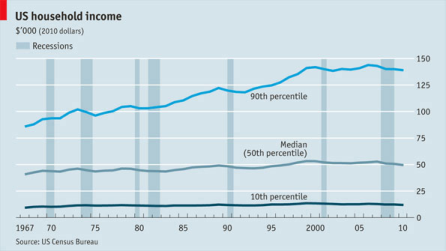
Income Groups over 40 Years


Note that if average tax rates have remained the same for the top 10%, and their income has risen--they are paying a higher proportion of the total tax burden now as compared to what they paid in 1970.

The debate is not so much that higher income earners should pay more---the issue is how much "more" is enough. 


This has real impact on markets. Fear that "surplus" income will be taken away in the future causes the investor class to take fewer risks--hence lower stock prices and lower interest rates.

This economic commentary is related to politics (political economy) and is the sole responsibility of the author and no other. It is not to be considered financial advice or a solicitation for political support.

Wednesday, September 14, 2011

Federal Income Tax Burden by Income Group


This info is from the Federal Reserve Bank of St. Louis. Link: Tax Burden at FRED for entire article. It, and the "Jeffersonian" quote from 1817 highlights the debate about "fairness" that underlies the other debate about the size of government currently raging in the USA. It is this debate and struggle that is the root of the uncertainty that is one major cause of the slowness in our economy.  Debt can only be eliminated with inflation or taxes. Spending in the long term therefore can only be offset by inflation or taxes. In either case, when government takes from one to give to another--it should be no surprise that the one who is burdened by the "taking" resists and is reluctant to "invest".

Note that the tax rate % for the highest 5% and the highest 20% has remained about the same since 1980.

Note also that the tax rate % for the other (lower) 80% has declined signficantly--with the lowest 20% actually getting more $ back from the government than they paid in. Nearly 40% are paying nothing.


Thomas Jefferson (1817) A TREATISE ON POLITICAL ECONOMY

"To take from one, because it is thought that his own industry and that of his fathers has acquired too much, in order to spare to others, who, or whose fathers have not exercised equal industry and skill, is to violate arbitrarily the first principle of association, ‘the guarantee to every one of a free exercise of his industry, and the fruits acquired by it."

Until this uncertainty is eliminated or reduced by a clear message sent by a national election, it is quite possible that economic activity may be sub-optimal.

This economic commentary is related to politics (political economy) and is the sole responsibility of the author and no other. It is not to be considered financial advice or a solicitation for political support.